The Mx Studio
SEO works best when the service pages, internal links, and local signals are all built around the enquiries you actually want.
GET FOUND FOR THE SERVICES YOU ACTUALLY WANT TO SELL
SEO for Brisbane SMBs that need the right service pages, local intent, and search visibility bringing better-fit leads.
4.9 stars on GoogleThe Mx Studio
SEO works best when the service pages, internal links, and local signals are all built around the enquiries you actually want.
Good search work starts with technical structure, local intent, clear service pages, and content that matches how people actually search. It is not about chasing plugin scores, padding reports, or pretending a green audit number is the same thing as commercial visibility. It also needs enough topical depth that Google, local search, and newer answer engines can tell which page is responsible for which service intent.
The page structure needs to show what you do, where you do it, and why someone in Brisbane should enquire now. If the site cannot support that yet, the smartest SEO move is usually to fix the foundation before layering on more content. That foundation is what turns later optimisation into compounding visibility instead of months of cleanup.
Some businesses need stronger suburb coverage. Others need help showing up in answer engines, or protecting rankings during a rebuild. Those are different jobs, with different page structures, supporting content, and measurement.
Splitting those jobs across the right pages makes the site easier to understand and gives each service a clearer place to rank. It also stops one broad SEO page from trying to carry every possible intent by itself.
Ranking is only useful when the traffic lands on pages that can turn search demand into calls, quote requests, bookings, or sales conversations. Empty impressions and vague traffic do not help if the page gives people no reason to trust the business. Fewer visits from the right searches are usually worth more than broad traffic that never reaches the buying stage.
We plan SEO around real customer intent, useful service pages, proof, and conversion paths so the work compounds into real enquiries instead of becoming another monthly report nobody acts on. That keeps the work tied to business outcomes instead of just movement on a dashboard.
Not sure which route makes the most sense? Book a free strategy call and we'll look at the website, the search opportunity, and the fastest useful next step for your business.
Show up for the right searches
Suburb and service intent needs to be mapped clearly across the site so Brisbane customers land on the page that actually matches what they typed. When that structure is loose, visibility gets diluted fast and the wrong pages start competing with each other, which is why local SEO usually needs to be built out properly.
Prepare the site for AI search
AI search tools need clean entities, clear answers, and structured context before they can trust what the website says. The clearer the information architecture and page intent, the more useful AI SEO becomes, but it still works best when the site already has solid SEO foundations and pages that are not fighting each other.
Protect migrations before traffic drops
Redesigns and rebuilds can wipe out useful rankings if redirects, internal links, and page intent are handled badly. Search equity is hard won and easy to lose, so SEO migration work protects that momentum while the site changes underneath it and helps avoid the quiet traffic losses people usually notice too late.
SEO works when technical structure, local intent, service pages, internal links, and content all point in the same direction. That is why the core service branches into Local SEO, AI SEO, and SEO migration instead of forcing every search problem into one generic retainer.
The work is planned around qualified leads, not vanity charts. If the website is still the bottleneck, the search strategy should be paired with web design so the pages, calls to action, and site architecture are doing their part as well.
You get a practical SEO system that can keep growing as the business adds services, suburbs, and campaigns, not a disconnected keyword spreadsheet that never turns into useful action.

“I’ll probably spend three hours fixing something you’ll never notice. You’re welcome.”
If local visibility matters most, start with local SEO. Good SEO work starts with crawlable service pages, clean headings, fast templates, logical internal links, and copy that matches real commercial intent before a report ever gets opened. That local structure usually becomes the clearest path to topical authority because each suburb, service, and supporting page has an obvious job to do.
AI search, local packs, organic listings, and paid results all reward businesses that explain their services clearly and back that up with a website structure search engines can trust. That same structure also makes AI SEO easier later because the site is already organised around entities, services, locations, and useful answers instead of filler paragraphs.
Once the foundations are right, new content, location pages, service pages, and ongoing optimisation have a much better chance of turning search demand into real enquiries. If the website is being rebuilt or moved, plan SEO migration before trying to scale everything else. Protecting the existing search value first usually gives the next round of content a much stronger base to grow from.
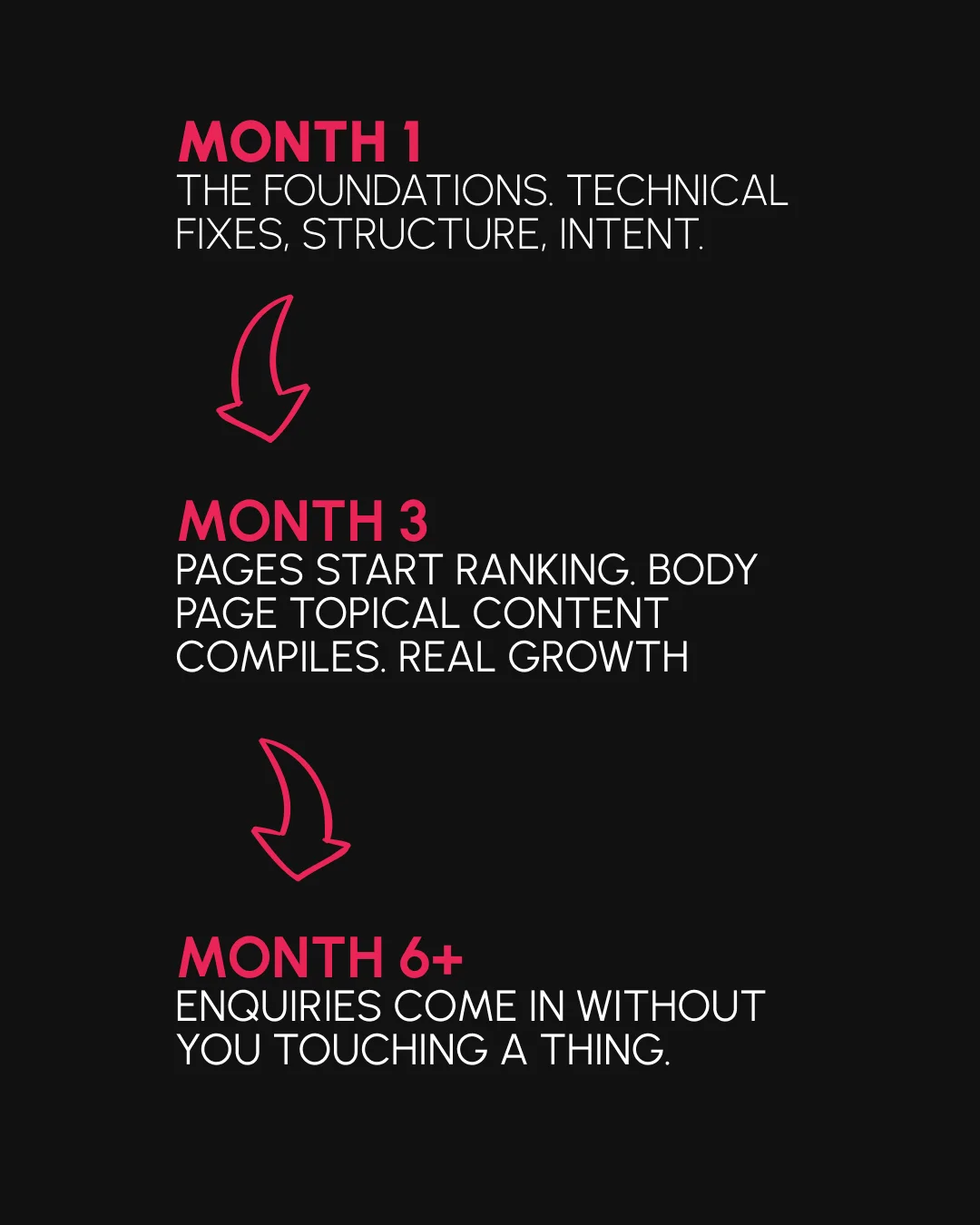
SEO is not instant. Some technical fixes and page improvements can help early, but most meaningful movement builds over months as the site structure, content, and authority signals start compounding. The timeline depends on competition, the starting point, and how much work the site actually needs. In practice, the clearest early wins usually come from fixing page intent and making the important service pages easier to trust.
It usually includes technical cleanup, service page planning, on-page improvements, internal linking, content direction, local search work where relevant, and reporting tied to enquiries rather than vanity metrics. The exact mix changes depending on whether the site needs a cleaner foundation or simply stronger ongoing execution. Some businesses mainly need better architecture and copy, while others need a deeper rollout of supporting pages and ongoing optimisation.
Not always. If the current site is structurally sound, SEO can improve what is already there. If the website is thin, confusing, slow, or built on weak foundations, part of the SEO conversation may be fixing the site first so the work has something solid to compound on. The point is not to rebuild for the sake of it, but to avoid pouring ongoing SEO effort into a structure that keeps holding the page back.
Yes. General SEO covers the broader search foundation, while local SEO focuses more heavily on maps, suburbs, and local service intent, and AI SEO focuses on how clearly the business can be understood by answer engines. They overlap, but they are not the exact same job. A good strategy usually connects them rather than forcing one page or one report to do everything.
Rankings matter, but they are not the end goal. We look at whether the right pages are earning better visibility, whether useful traffic is growing, and whether that traffic is turning into calls, forms, bookings, or sales conversations. That keeps the reporting tied to commercial intent instead of just celebrating movement on broad, low-value terms.
No responsible SEO provider should guarantee exact rankings because search results change constantly and no one controls Google. What can be controlled is the quality of the structure, the relevance of the content, the usefulness of the pages, and the clarity of the strategy behind the work. That is the part that gives the site a better chance to keep improving even as the search landscape keeps shifting.
Tell us about what you need from your website. We’ll talk through your project and recommend the right next step